Wednesday, February 23, 2011

Alex K. Scribe Post 2/23/11

Today we learned about common angles names. We learned about Θ"Theta", α"Alpha" and β "Beta".
R---> Radius = 1 unit
S----> Arc length
Θ=s/r
Θ can only be in radians using this formula.
Circle=360° or 2πr

Since the central angle and the arc length are the SAME, put the central angle in radians because radians are the same unit as length and the arc length cannot be in degrees.
Learning that the central angle and the arc length are the same is very interesting to me. It seems like it's just a coincidence but it can't be and that's what's so cool about it, that someone took the time and really worked at this and figured it out. It's crazy.

Adan Scribe Post: Day 13- Feb. 22 2011

Today Jojo sarted teaching section 1.2 which is about radian measure. A radian is the measure of and arc's length. He talked about how in the radian system of angular measurement, the measure of one revolution is 2pi, half a circle is pi, each right angle is pi/2 and so on. He also talked about the most common measurements and their degree. Here are some of those:
pi/4 = 45 degrees
pi/3 = 60 degrees
pi/6 = 30 degrees
2pi/3 = 120 degrees

and so on.

Monday, February 21, 2011

Kelsey Scribe post 2/16


Today we learned about coterminal angles, quadrants and degree measures of angles.

We were taught that there are four quadrants (I, II, III, IV) and how to determine which quadrant an angle lies in.

How to find coterminal angles m(beta) = m(alpha) + k360

Here is a good website that explains everything in depth and clears up alot of confusion
http://www.themathpage.com/atrig/measure-angles.htm

example of coterminal angles

Wednesday, February 9, 2011

John Henry Scribe Post 2/9/2011

Today Jojo explained the quadratic formula F(x)= ±a(x±h)±k

F(x)= ±a(x±h)±k

determines where on the x axis the shape is

determines where on the y axis the shape is

Whether or not on x axis

a >1 stretch

01


here is a website with some great examples:

http://uncw.edu/courses/mat111hb/functions/inverse/inverse.html

you can also use page 33 in your book

next scribe: Kelsey

How to determine if two functions are inverses of each other....

Tuesday, February 8, 2011

Elijah Scribe Post - 2/8/11

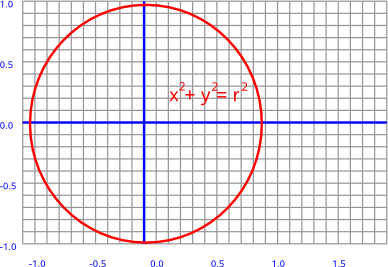
Today we discussed functions. We had a long debate about whether the area of a circle is a function. We came to the conclusion that a circle is not a function because it has more than one value for x for each value of y. Since it is the day after the Super Bowl, I decided to find out if the area of the outline of a football is a function. It also is not a function because of the same reason as a circle.